Followers

Monday, November 22, 2021

20210526 - 0602 St. Peters, MO 20210602 - 0605 Potosi, MO, 20210608 - 0613 Sunbury, OH

Our new Sleep Number Bed and visiting Loretta near Bonne Terre Missouri. Then heading east. 

370 Lakeside Park, St Peters, Missouri - 27 May - 31 May 2021
One of our regular stops near St. Louis. A very nice, large community park and campground. 

What? No mattress! Our new Sleep Number bed is in pieces. We better get busy if we don't want to sleep on plywood. We want to send an extra special Thank You to Jim and Jan for allowing us to have this shipped to them and letting us leave our old mattress for pick up at their house. We certainly could not have done this without your help and thoughtfulness. Two years trying to replace the original RV mattress because Sleep Number would not deliver it to a non-residential location and then Covid crashed the delivery system. 


First the area is cleaned. Next we read the manual and start the build process. The air pump goes under the platform so a hole has to be drilled through the wood to allow the air tubes to attach to each liner. Using the remote to fill the liner. What's your number?

Read all the instructions. Zip on the mattress pad and cover and finish filling. Easy as pie. Now there is more room to move around since we retired a king mattress and got a queen. I'm tired... let's go to bed. 馃挙

Only clean dogs are allowed in bed. Tori gets a bath. Can't understand why a dog that enjoys going into rivers is so sad when she gets a bath.  


We 馃挆 our campground at Twin Eagle Lake Estates and Hideout, Potosi, Missouri - 02-05 June 2021
We stay at this campground when we visit our cousin, Loretta. It's an all gravel campground but the sites are long and generous in width. The lake is big enough for boats and there is a "beach" for swimmers. 


Loretta enjoys Tori's company because she understands what it is like to get older.  She love's the way Dakota is constantly talking (though we call it whining). We hear lots of stories and try to help Loretta with little things like changing lightbulbs and batteries.

The traditional impatiens in the front garden needed some watering while we were there. Two turtles being friendly in the backyard and Dakota telling everyone about their activities. 

A brief stop at Sunbury KOA in Ohio 08 -13 June 2021
A short stay in Ohio before continuing on to Pennsylvania. We were happy to have a site back in the Boondocks since most of the day was shaded. Hot and steamy in Ohio so Tori needed a nap after a walk around the park. 


Tuesday, November 2, 2021

20210519 - 0525 Marengo, IL


A visit to Chicago
A nice walk to Lake Michigan - 20 May 2021

Lake Michigan with Loyola University in the background. Kristen flew in for our visit with Betty and Norm. A surprisingly warm May until we walked over to the Lake Michigan shore where the temperatures dropped by 10 degrees. 

Morning at Betty and Norm's, a day at the Museum and dinner out - 21 May 2021
Betty and Norm's cozy living room and bright sun room with bay windows.

The famous Field Museum of Chicago.

In classic Kristen style, she has her own unique vision of photography and is not shy about getting the perspective while lying on the floor. The duo pachyderm scene, "Fighting African Elephants", has stood sentry in the main hall since 1905.

The newest exhibit tracked the career of Jane Goodall from childhood through her innovative study of chimpanzees in Tanzania's Gombe Stream National Park. The exhibit contained early childhood items and a replica of her field research tent. It also uses augmented reality technology allowing guests to interact with hologram-like projection of Dr. Goodall.

Backyard seating at the Anteprima Italian restaurant. A delicious meal but be aware of the falling tree seeds. And watch your time which is limited to 50 minutes. With dining just starting up again after the Covid lockdown, restaurants are limiting patrons seating time to maximize the turnover of tables. 

A covid car and lunch with Michaela and Byron - 22 May 2021

Walking around there are some interesting things to see including this coronavirus car. Maybe it was just an artistic statement or a political one but it certainly attracted some attention. 


Lunch with Michaela and Byron at Machine Engineered Dining & Drink. Bob and Betty got the fancy drinks while Byron and Michaela promoted a less than savory libation, Jeppson's Malort Liqueur. As we understand it, Malort is very nasty tasting which seems to make it a challenge for the adventurous types.  

Last Day, Neighborhood art, Breakfast, Goodbyes - 23 May 2021

A nice morning walk with the dogs past the self-expressive gardens around Betty and Norm's neighborhood. 

A hearty breakfast of French toast and fruits. All these years of visiting and we never noticed the gargoyle above the door. 

Heading back to our trailer it was a bit crowded in the back seat. 

Airport "Goodbye". Always enjoy spending time with Kristen. 


Wednesday, September 22, 2021

20210425 - 0427 Las Vegas, NM

On the way to Las Vegas, New Mexico

The VLA - Very Large Array 50 miles west of Socorro NM - 24 April 2021

National Radio Astronomy Observatory. There are 27 active 25-meter radio telescopes and 1 spare. Astronomers use the VLA to make key observations of black holes, young stars etc.
Las Vegas, New Mexico

Pecos National Historical Park, NM - 25 April 2021

People have traveled through and lived in the Pecos Valley for thousands of years entering via the Glorieta Pass which lies between the Sangre de Cristo mountains and Glorieta Mesa.    
This included Pueblo and Plains Indians, Spanish conquerors and missionaries, Mexican and Anglo armies, Santa Fe Trail settlers and adventurers. Abandoned during the 1700s, the settlement ruins were witness to the struggle between the Union and Confederate forces who clashed in the Pass to the west deciding the fate of the Civil War in the West. 

 
The remains of the Spanish Church above dates from 1717. This is the second and last church. It was smaller than the first church built in 1625 which was destroyed by the Pueblo revolt in 1680. 

Another view of the remains of the 1717 church. The extensive grounds surrounding the church are sectioned off by short stone walls and paths leading to dwellings on the nearby hills.


Kiva? This is the only covered underground space we have seen in our travels. It does not appear to be a Kiva (though there are similarities) because there are no ledges around the walls for participants to sit on plus the roof is flush to the ground outside. The kiva examples we have previously seen had post holes on the outer edge to support the roof. 


Bob took his turn going into the below ground space while Dakota patiently waits at the ladder. 


Fort Union National Monument, NM - 26 April 2021


Fort Union was established in 1851 as the guardian of the Santa Fe Trail. It commanded the intersection of the Mountain and Cimarron Branches of the Trail. Fort Union served both military and civilian functions. Prior to the Civil War, the Fort’s troops patrolled the trail and later escorted mail stages. During the Civil War, the combination of Native American conflicts and raids by Confederates from Texas led to the troops’ protection of all travelers and efforts to keep open the Santa Fe Trail. Three different forts were built close together on the site during its forty-year history. The third Fort Union was the largest in the American Southwest and functioned as a military garrison, territorial arsenal, and military supply depot for the Southwest. The railroad bypassed Fort Union in 1879, and its supply operations were gradually phased out. 1883 saw the closure of the depot. Today at Fort Union National Monument (FOUN), one can tour fort remains and see the largest visible network of Santa Fe Trail ruts.

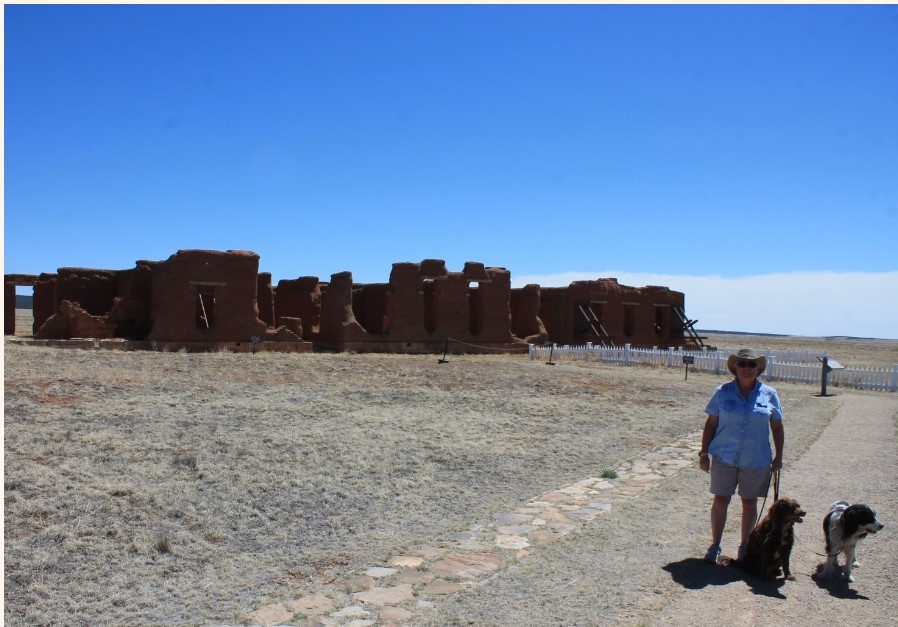
Exposed to the prairie winds, these adobe walls are all that remain of one of the largest US Army Supply Depots of pre-Civil War era. In use from 1862-1891, Fort Union was constructed of native resources such as clay, stone and lumber. The walls was made of adobe brick that stood on a foundations of stone and coated with plaster fired in limekilns. Other materials, such as nails, roofing tin, tools, window glass, and fire bricks were transported from Fort Leavenworth, Kansas.  

The Mechanic's Coral employed mostly civilians to maintain the constant stream of wagons, military and civilian, which rolled along the Santa Fe Trail. With four companies of both cavalry and infantry, the Depot Quartermaster was equipped to supply every fort in the New Mexico territories. 

Depot Transportation Coral for storing, loading and unloading supplies destined for the other frontier forts. The eight acre footprint of Fort Union provided barracks for enlisted soldiers, housing for officers, storehouses (these are massive and hundreds of feet long), blacksmith/tinner shops, saddler and carpenter shops, stables for horses and mules, coal house, bakery, tool house, clerk quarters, cisterns for water collection and gun shed. The military arsenal was outside the Fort, about a mile away for safety. An 1862 Inspection report of the arsenal listed 21 cannon of various calibers, some 5,600 rounds of artillery ammunition, almost 7,100 small arms (muskets, rifles and revolvers), and 2.8 million small arms cartridges.  


Separated from the workings of the depot and the housing for troops and officers, the hospital was segregated away from the activities, smells and noises associated with the Depot. 

 
As the second fort was being completed in early 1862, the Confederates were already marching north up the Rio Grande Valley. Under the command of Brig. Gen. Henry H Sibley, the Confederates were on their way to Albuquerque, Santa Fe, Fort Union and eventually the Colorado gold fields. By early March 1862, the Confederates had taken Santa Fe, with only Fort Union standing between the invaders and the Colorado gold fields. Their plan was to use the gold and silver mines of California and Colorado to fund the expansion of the war into the western territories thereby stretching the Union Army over the entire south even as far as California. They also wanted to seize the seaports of California to evade a Union naval blockade.

The soldiers of Fort Union joined forces with the Colorado Volunteers and headed south to challenge the Confederates. The two armies confronted each other at Glorieta Pass, between Santa Fe and Pecos, NM. The Battle of Glorieta Pass, fought from March 26-29, 1862, was the decisive battle in the New Mexico Campaign during the Civil War in the West. Union forces successfully defeated the Confederate forces when the southerner's wagon trains were destroyed. With the loss of their supplies, the Confederates were forces to retreat back to Texas.   


Tuesday, September 7, 2021

2021 04/16 - 04/19 Pie Town, NM. 04/19 - 04/24 Bosque, NM


Pie Town, New Mexico

Pie Town RV Park, NM - 17 & 18 April 2021

How quickly things change especially when we are at 7,778 feet. It wasn't much of an RV park just 6-8 sites in a row and a set of restrooms/showers. It was jacket weather when we arrived but the new day was definitely cold. 

The online description says Pie Town is an unincorporated community. We may not know what constitutes a community but in this case a restaurant and a City Park does the trick. Its name comes from an early bakery that made dried-apple pies by Clyde Norman in the 1920s. We only stayed a short time (enough for two pie runs) but there also the Gila National Forest and not far west is the location of the Very Large Array radio telescope. We were very sad the array was closed due to Covid. 

Interesting picture showing the remote area. We were getting gas across the street and captured this scene.  Interesting sculpture, tiny credit union and cowboy with horse in the reflection. 

Bosque, New Mexico

Bosque del Apache National Wildlife Refuge, NM - 20 April 2021

We were not as lucky this time as our last trip when we had hundreds of sandhill cranes. New Mexico was having a difficult time with Covid and so the Visitors' Center was closed. 


No sandhill cranes this time but Glossy Ibis were prevalent. A small herd of deer paraded through a field. A white Heron, some Snow Geese, Great Blue Heron and several wild Turkeys.


Unknown songbird. Turtles sunning themselves along the drainage ditch. Several ducks. 

Salt, Societies, and Spirituality: A Tale of Two Cultures

Tucked away in the middle of New Mexico you’ll find Salinas Pueblo Missions National Monument.  Its three distinct sites offer a glimpse into a unique time in history—a time entrenched with cultural borrowing, conflict and struggles.  These sites continue to stand as reminders of the Spanish and Pueblo peoples’ early encounters and prompt exploration of today’s interactions among different people.

Gran Quivira unit, NM - 22 April 2021

The Gran Quivira unit of Salinas Pueblo Missions National Monument is the largest of the three units at 611 acres. Prior to Spanish contact, Gran Quivira was a vast city with multiple pueblos, and kivas.

The surface of the area had many noticeable low areas where water would accumulate. The native population could store this water in pottery for the drier times. One of several Kivas. 

Underground area at the top of the rise is known as Mound 7 and consists of a 226 room structure for the period of 1300-1600. During some later excavation, an older Circular Pueblo was discovered under this same mound. 

The sandpipers seemed to be pretty comfortable with visitors but did keep a close eye on us as we walked around. The large walls are part of the mission. By 1672, a combination of disease, drought, famine and Apache raiding led to the abandonment of Gran Quivira. 


Quarai Mission and Convento, NM - 23 April 2021

The Quarai Mission and Convento were established at Quarai in 1626 overseen by Fray Juan Gutierrez de la Chica. Construction began on La Purisma Concepcion de Quarai in 1627 and continued to 1632.

A windy, cold day out at the second of three sites in the area. Behind the dogs and me are the remains of a Quarai Mission while we are standing in the Convento. 

The massive height and depth of these walls were stunning in size. The covered portion at the bottom of the walls was a repair for damages and to prevent additional damage. 

A scale reproduction of the Quarai and the Convento. 

Ab贸 Unit, NM - 23 April 2021

The Ab贸 Unit of Salinas Pueblo Missions National Monument sits west of the town of Mountainair, New Mexico, and contains approximately 370 acres. 

In 1622, Fray Francisco Fonte was assigned to the Ab贸 Mission. Working with the Puebloans he built an early small Ab贸 Church and Convento starting in 1623. In 1640 a second missionary, Fray Francisco Acevedo, was assigned to Ab贸. He built a larger Ab贸 church and convento.  This new, larger church was built around the smaller church, allowing services to continue. A combination of disease, drought, famine, and Apache raiding led to the abandonment of Ab贸 in 1673.

A circular Kiva?  This kiva was built about the same time as the Ab贸 church and convento between 1623 and 1628. A Puebloan kiva is  equivalent of a community center. So what was it doing on the church grounds? Possibly this structure was used in early conversion efforts. It is not really known. Interesting. 


Sunday, August 15, 2021

20210409 - 0416 Winslow, AZ


Winslow, Arizona

Walking around Winslow, AZ - 10 April 2021


Peter Toth is a Hungarian-American sculptor who immigrated to Akron, Ohio. He created a series of sculptures called Trail of the Whispering Giants to honor Native Americans. Ranging in height from 20 to 40 feet, there is one in every state, as well as Ontario and  Manitoba, Canada and one in Hungary. Sculpture: #33, dedicated 1979 or 1980. Ponderosa Pine.


Walking from the Visitor's Center into downtown Winslow along the tracks and through the city park. 

Picture this. "Standing on the corner in Winslow Arizona" along Historic Highway 66. The building fa莽ade was built on donated property (see below for tribute).

The official "Standing on the Corner in Winslow, Arizona" statue of Glen Frey, who along with Jackson Browne wrote the song most famously recorded by the Eagles. And My Lord, that is a flat bed Ford though we did not see any girl driving it.

Taking a rest before heading out to La Posada Hotel.

The last Harvey House, La Posada Hotel opened in 1930. The hotel closed in 1957 and the building was used by the Santa Fe Railway for offices. The railroad abandoned the La Posada in 1974 and announced plans to tear it down. It was bought and restored by Allan Affeldt and reopened as a hotel. 

Originally, designed by architect Mary Jane Colter, considered a masterpiece of Southwest design, La Posada means "the resting place".   

Several outdoor walking gardens within the walled area in front of the hotel. There are indoor art galleries, a gift shop which features authentic Native American jewelry, rugs, pottery and wall art, and halls are generously decorated with antique photos and d茅cor.

Original terra cotta tiles and wrought iron railing is one way to access the second floor rooms but an elevator is available if desired for those with luggage or needing assistance. The Turquoise Room is the hotel's award winning restaurant. A pretty silver tree.

Meteor Crater RV Park near Winslow, AZ - 11 April 2021

Left: our Home. Right: view of San Francisco Peaks looking toward Flagstaff, AZ

Walnut Canyon National Monument, AZ - 12 April 2021

More than 700 years ago there was a pueblo community of Native people called the Sinagua ("without water") who were the first permanent inhabitants. There were scattered families farming the canyon rims for centuries. 

Stairs provide access to the Island in the Canyon but along the way several cliff dwellings can be seen around the canyon walls. The 240 stairs going down are not nearly as difficult as the 240 going up.

Few animals can be seen during the day but the Park Rangers assured us that squirrels, foxes, coyotes, elk, turkeys, owls, hawks, snakes, crows and even the occasional mountain lion have been documented in the canyon. After descending several hundred steps the easy walking path circles the island for close up views of the cliff dwellings. 

some dwellings are severely damaged while others have complete wall enclosures. 

The sides of the canyon provide plenty of cover and were used for farming small plots of crops. Plus nature provided additional foods such as this Claret Cup. The bottom of the canyon has water for people and animals. 


The Turquoise Room, Winslow, AZ - 12 April 2021

Returning to The Turquoise Room in La Posada Hotel, Winslow, Arizona for dinner. The name is derived from the 1935 private dining car for the Super Chief train that was to run from Chicago to Los Angeles and designed by Mary Jane Colter. The dining car was a favorite among studios chiefs and Hollywood stars of the day. The hotel's restaurant is accessible by railroad as it is an Amtrak stop. If you are interested, the pink beverage is a Prickly Pear Margarita, the two medallions are elk with a pomegranate sauce (recommended cooked rare unless you like shoe leather). Bob had Free Range Bison Short Ribs decorated with watermelon radish slices.

Petrified Forest and Painted Desert, AZ - 13 April 2021

Self-portrait since he rarely gets in photos. 

Now this is an interesting desert created by volcanic eruptions, earthquakes, floods, and sunlight. 

The bad news; the visitor center was closed. The good news; the bathroom was open. There were a couple picnic tables at the back which allowed us to eat lunch out of the very strong winds.  

It was a very windy day. But we both left with our hats intact. 

Time for lunch. Here's our nice little table in the shade and protected from the wind. Originally made of petrified wood, Herbert David Lore registered the Stone Tree House with the land office in 1924 as required by the Homestead Act. It had six small rooms for rent at two to four dollars per night. The current Painted Desert Inn dates from the 1930s and has an adobe fa莽ade. 

Interiors through windows of the interior building. The Inn is currently closed for renovations, only serves as a museum with no accommodations or food service.  


Puerco Pueblo ruins had almost 100 rooms and was occupied between 1250 and 1380. The river floodplain provided farming opportunities for corn, beans and squash. The river also provided a travel corridor for outlying communities up and down the river. 

Historic Contact Station has details of research studies of interactions through a wide variety of artifacts and rock art found in or near the village.  

Petroglyphs show different styles of art. 


Petrified logs - trees that fall and is buried by sediment and protected from decay due to oxygen and organisms. Then, groundwater rich in dissolved solids flow through the sediment, replacing the plant material with silica, calcite, pyrite or another inorganic material like opal. The result is a fossil. 

Agate Bridge. The tree grew 217 million years ago and was buried by river sediment and slowly became petrified. In 1917 a concrete support was built. This will eventually be washed away with the bridge and is not stable enough now for crossing. 

Some of the giants behind the Visitor's Center. Fracturing is made by water freezing and thawing, the same as in any other stone. 

A Bob sized root and a close up of the bark.

Our last day at Meteor Crater RV Park, AZ - 16 April 2021

We had several days of windy conditions which severely limited our view of the San Francisco mountains due to the amount of sand picked up. Spectacular view of the snow caps.